History of Cryptography
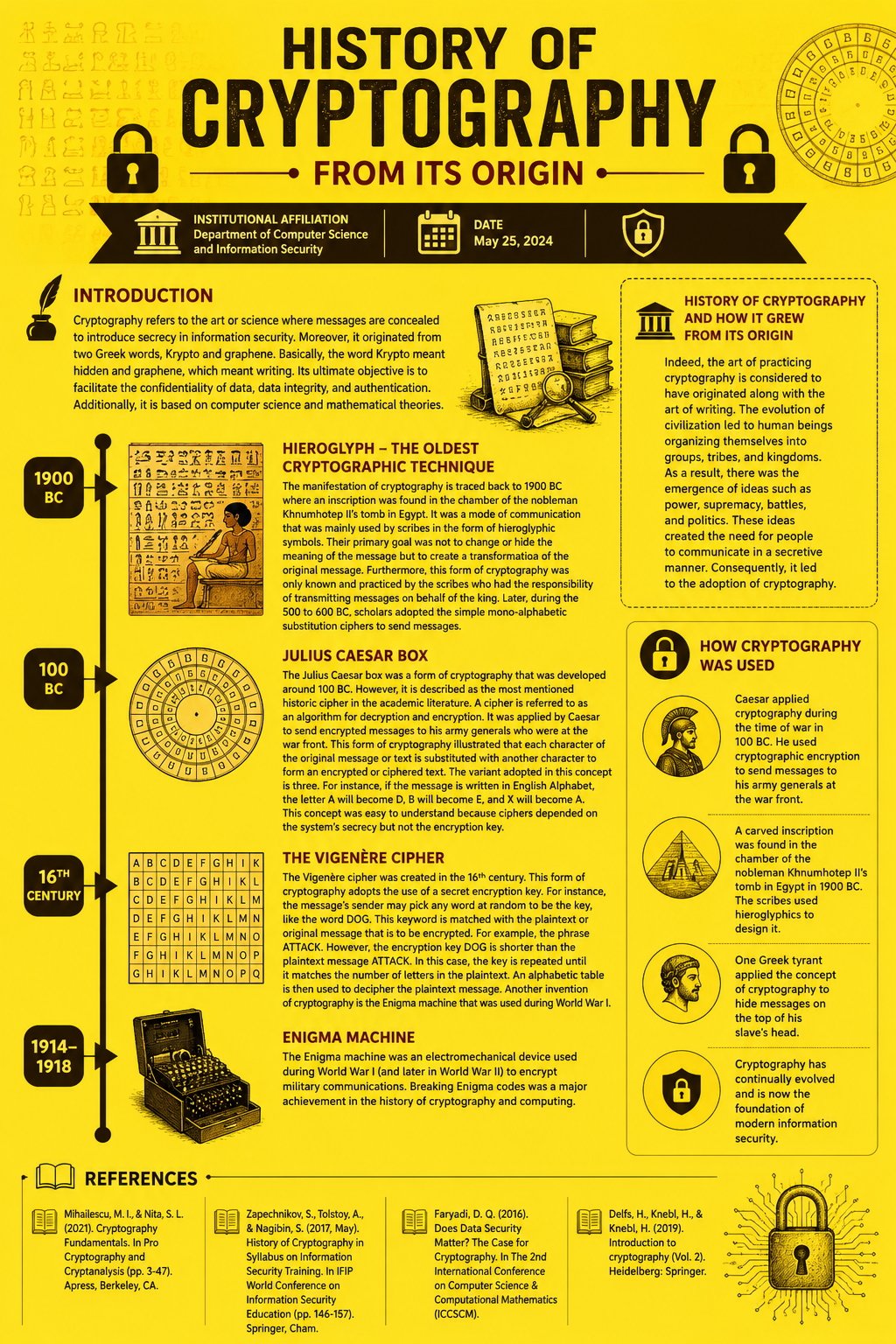
History
of Cryptography from its Origin
Institutional Affiliation
Date
Introduction
Cryptography
refers to the art or science where messages are concealed to introduce secrecy
in information security. Moreover, it originated from two Greek words, Krypto
and graphene. Basically, the word Krypto
meant hidden and graphene, which meant writing (Mihailescu et al., 2021). Its ultimate objective is to
facilitate the confidentiality of data, data integrity, and authentication.
Additionally, it is based on computer science and mathematical theories.
History
of Cryptography and how it grew from its Origin
Indeed,
the art of practicing cryptography is considered to have originated along with
the art of writing. The evolution of civilization led to human beings
organizing themselves into groups, tribes, and kingdoms. As a result, there was
the emergence of ideas such as power, supremacy, battles, and politics (Mihailescu et al., 2021). These
ideas created the need for people to communicate in a secretive manner.
Consequently, it led to the adoption of cryptography.
Hieroglyph
-The Oldest Cryptographic Technique
The
manifestation of cryptography is traced back to 1900 BC where an inscription
was found in the chamber of the nobleman Khnumhotep II's tomb in Egypt. It was
a mode of communication that was mainly used by scribes in the form of
hieroglyphic symbols. Their primary goal was not to change or hide the meaning
of the message but to create a transformation of the original message (Zapechnikov et al., 2017).
Furthermore, this form of cryptography was only known and practiced by the
scribes who had the responsibility of transmitting messages on behalf of the
king. Later, during the 500 to 600 BC, scholars adopted the simple
mono-alphabetic substitution ciphers to send messages.
Julius
Caesar Box
The
Julius Caesar box was a form of cryptography that was developed around 100 BC. However,
it is described as the most mentioned historic cipher in the academic
literature. A cipher is referred to as an algorithm for decryption and
encryption. It was applied by Caesar to send encrypted messages to his army
generals who were at the war front. This form of cryptography illustrated that
each character of the original message or text is substituted with another
character to form an encrypted or ciphered text (Zapechnikov et al., 2017). The variant adopted in this
concept is three. For instance, if the message is written in English Alphabet, the
letter A will become D, B will become E, and X will become A. This concept was
easy to understand because ciphers depended on the system's secrecy but not the
encryption key.
The
Vigenere Cipher
The
Vigenere cipher was created in the 16th century. This form of
cryptography adopts the use of a secret encryption key. For instance, the message's
sender may pick any word at random to be the key, like the word DOG. This
keyword is matched with the plaintext or original message that is to be
encrypted. For example, the phrase ATTACK. However, the encryption key DOG is
shorter than the plaintext message ATTACK. In this case, the key is repeated
until it matches the number of letters in the plaintext. An alphabetic table is
then used to decipher the plaintext message (Faryadi et al., 2016). Another invention of
cryptography is the Engima machine that was used during World War 1.
How
Cryptography was used
Caesar applied
cryptography during the time of war in 100 BC. He used cryptographic encryption
to send messages to his army generals at the war front (Faryadi et al., 2016). This concept assisted
in preventing messages from being intercepted by unintended recipients.
Moreover, cryptography was applied where a carved inscription was found in the
chamber of the nobleman Khnumhotep II's tomb in Egypt in 1900 BC (Delfs et al., 2019). The scribes
used hieroglyphics to design it. More specifically, one Greek tyrant applied
the concept of cryptography to hide messages on the top of his slave's head.
References
Mihailescu, M. I., & Nita, S. L. (2021).
Cryptography Fundamentals. In Pro Cryptography and Cryptanalysis (pp.
3-47). Apress, Berkeley, CA.
Zapechnikov, S., Tolstoy, A., & Nagibin, S.
(2017, May). History of Cryptography in Syllabus on Information Security
Training. In IFIP World Conference on Information Security Education (pp.
146-157). Springer, Cham.
Faryadi, D. Q. (2016). Does Data Security
Matter? The Case for Cryptography. In The 2nd International Conference
on Computer Science & Computational Mathematics (ICCSCM).
Delfs, H., Knebl, H., & Knebl, H. (2019). Introduction
to cryptography (Vol. 2). Heidelberg: Springer.