Women in film and television
The Place of Women in Film History
Student's Name
Institutional Affiliation
Course Name
Professor's Name
Date
Introduction
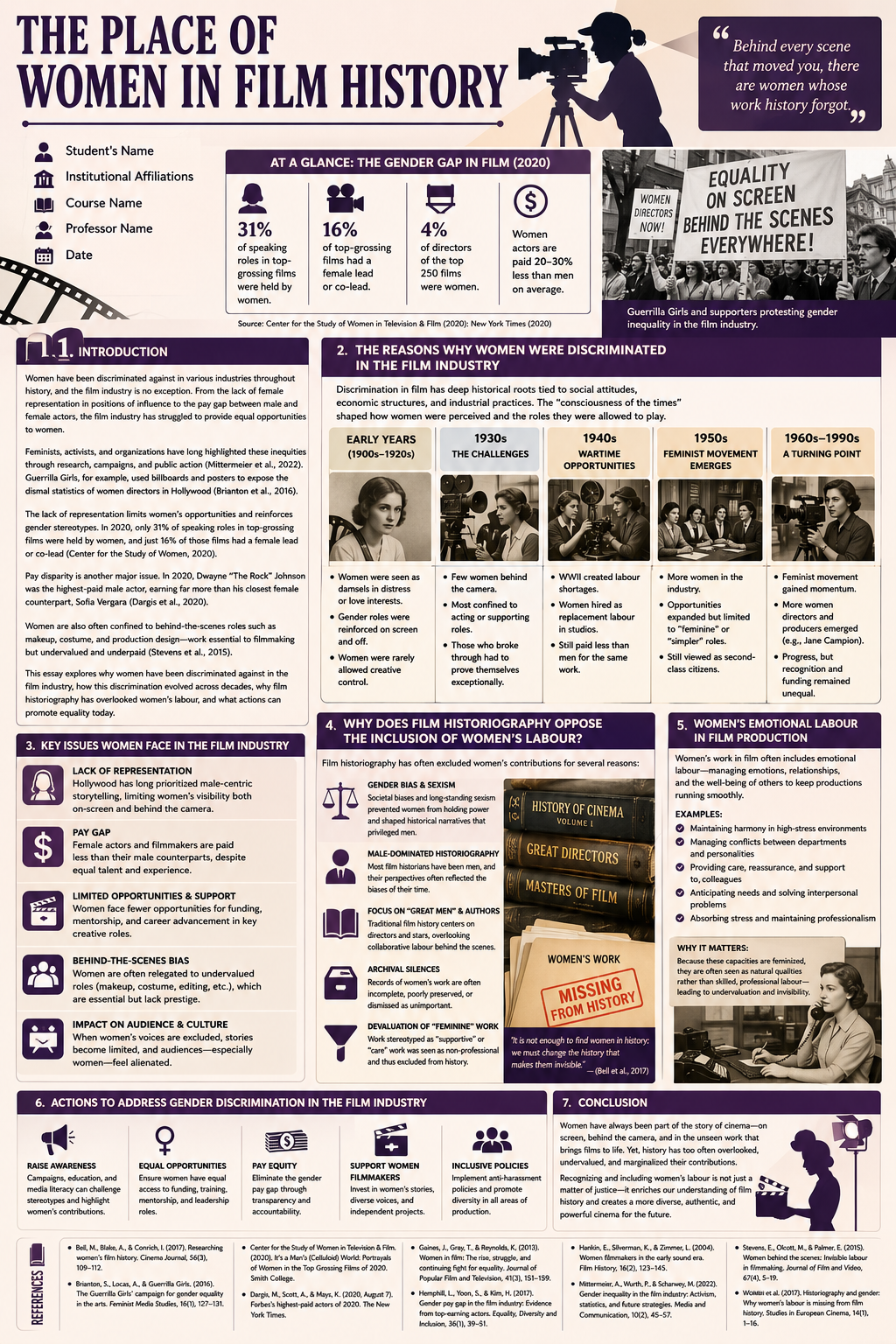
Women
have experienced discrimination in various industries throughout history, and
the film and television industry is no exception. Despite significant progress
in recent decades, gender inequality continues to affect women's
representation, employment opportunities, recognition and remuneration. From
the limited representation of women in influential positions to differences in
pay between male and female performers, the entertainment industry has faced
persistent challenges in providing equal opportunities.
Research
and advocacy by women activists and feminist organizations have highlighted
inequalities affecting female filmmakers, particularly in independent
filmmaking and Hollywood. Mittermeier et al. (2022) discuss the continuing
challenges women encounter in obtaining funding, professional support and
opportunities comparable to those available to their male counterparts. These
concerns have encouraged advocacy projects and organizations to raise awareness
and challenge discriminatory practices. Explore our
academic writing services or visit our homepage to learn
more about WriterSolutionsPro.
One
significant concern is the underrepresentation of women in leading roles and
influential creative positions. Hollywood has historically produced many
male-centred narratives in which men occupy prominent roles while women are
frequently portrayed as supporting characters, romantic interests or victims
requiring rescue. Feminist artists and activist groups, including the Guerrilla
Girls, have challenged these inequalities through campaigns, posters and public
demonstrations. Such campaigns have drawn attention to the limited number of
women working as directors and other senior creative professionals (Brianton et
al., 2016). When women are excluded from influential positions, their
opportunities to contribute their perspectives and demonstrate their creative
abilities become restricted. Get academic writing
assistance or explore our website.
Another
major concern is the gender pay gap and unequal access to professional
opportunities. Although female actors and filmmakers may possess comparable
experience, skill and professional achievements to their male counterparts,
they can face differences in remuneration, contract negotiations, financing and
career advancement. Dargis et al. (2020) discuss issues relating to gender and
the entertainment industry, highlighting broader questions about recognition
and professional inequality. Differences in earnings can affect women's
financial security, bargaining power and ability to sustain long-term careers.
Addressing these inequalities requires greater transparency, fair employment
practices and equitable access to professional opportunities. Explore our academic support services or visit our homepage.
Women
have also historically been concentrated in certain behind-the-scenes
occupations, including costume design, makeup and production design. These
roles are essential to filmmaking, yet the recognition and prestige attached to
different occupations have not always been distributed equally. Stevens et al.
(2015) discuss issues surrounding women's contributions and professional
recognition in film-related work. When some occupations are undervalued or
associated with traditional gender expectations, women working in those areas
may encounter barriers to career progression and leadership. A fairer industry
should recognize the creative and technical contributions of women across all
departments. Request academic writing support
or learn more about WriterSolutionsPro.
The
consequences of gender discrimination extend beyond individual careers. When
women have limited opportunities to direct, write, produce or lead major
projects, the range of stories represented on screen can also become
restricted. Greater inclusion can introduce audiences to different experiences,
perspectives and forms of storytelling. The main objective of this essay is to
examine the place of women in film history, explore the historical and
structural reasons for their discrimination, and consider measures that may
promote greater gender equality in the film and television industry. Explore our academic writing services or visit our homepage.
The
Reasons Why Women Were Discriminated Against in the Film Industry
Feminist
organizations and other advocates can promote greater representation of women
in film and television, but understanding the historical causes of
discrimination is also essential. Examining earlier films, documentaries and
historical accounts can reveal how social attitudes and professional structures
influenced women's opportunities. Hankin et al. (2007) discuss documentaries
relating to women filmmakers, including Sisters in Cinema, Zero
Budget, Lavender Limelight, In the Company of Women and A
Journey Through Women's Cinema. Such works can help audiences examine the
experiences of women filmmakers and understand how their opportunities were
shaped by the social and cultural conditions of their times. Get help with academic writing or visit
our homepage.
One
historical factor contributing to discrimination was the portrayal of women as
dependent characters who required protection or rescue by male heroes. These
representations often reinforced traditional gender stereotypes, presenting men
as active decision-makers and women as passive participants. Although not every
film followed this pattern, repeated portrayals could limit the kinds of roles
available to women and influence assumptions about their capabilities. Similar
attitudes affected opportunities behind the camera, where directing, producing
and other leadership positions were frequently associated with men. Explore our academic support services or visit our website.
During
the 1930s, women continued to face barriers to influential positions in parts
of the film industry. Although women worked as performers and contributed to
many aspects of production, they were often underrepresented in senior creative
and technical roles. Hankin et al. (2004) discuss historical conditions
affecting women working in filmmaking. Professional expectations, employment
practices and limited access to decision-making positions could make it
difficult for women to establish themselves as directors, producers or other
industry leaders. These barriers contributed to the persistence of gender
inequalities in professional recognition and career advancement. Request academic writing assistance or visit
our homepage.
The
1940s brought changes to film production during the Second World War. Wartime
mobilization affected employment patterns, studio operations and the
availability of workers in several industries. Women entered or expanded their
participation in various occupations as labour needs changed. However,
increased participation did not necessarily eliminate gender inequality. Women
could still face unequal pay, limited promotion opportunities and assumptions
that their employment was temporary. These historical developments demonstrate
that access to employment alone does not guarantee equal treatment,
professional recognition or long-term career progression. Explore our academic writing services or learn more about WriterSolutionsPro.
During
the 1950s, traditional expectations concerning women's domestic
responsibilities continued to influence many areas of social and professional
life. These attitudes were also reflected in film narratives, where women were
frequently portrayed as homemakers, supporting characters or romantic
interests. Gaines et al. (2013) provide a basis for examining the relationship
between gender, cultural expectations and representation. Women who sought
careers as filmmakers and producers could encounter difficulties obtaining
financial support, recognition and opportunities to develop their projects.
Consequently, women's representation in cinema often reflected the wider social
attitudes of the period. Get academic writing
support or visit our homepage.
The
1960s through the 1990s and into the new millennium marked important periods of
change in discussions about gender equality. Feminist movements increasingly
challenged discriminatory practices and called for greater access to education,
employment and creative leadership. More women gained recognition as directors,
screenwriters and producers, although progress varied across countries,
industries and professional roles. Jane Campion's achievement at the Cannes
Film Festival, where she shared the Palme d'Or in 1993 for The Piano,
was an important milestone in the recognition of women directors. Such
achievements demonstrated women's creative capabilities while also drawing
attention to their continued underrepresentation in prestigious filmmaking
spaces (Mittermeier et al., 2022). Explore our
academic services or visit our homepage.
In
more recent years, movements such as #MeToo and Time's Up have increased public
attention to sexual harassment, workplace abuse and gender inequality in the
entertainment industry. These movements have encouraged discussions about
accountability, safer working environments and fairer professional practices.
Nevertheless, challenges remain in areas such as directing, writing, producing,
financing and senior industry leadership. Women of colour may also face
overlapping barriers related to race and gender. Sustainable progress requires
meaningful institutional changes, fair recruitment and promotion practices,
transparent compensation and effective measures for addressing harassment and
discrimination. Request academic writing assistance
or visit WriterSolutionsPro.
Why
Does Film Historiography Oppose the Inclusion of Women's Labour?
Film
historiography examines how film history is recorded, interpreted and
presented. Ideally, it should provide an accurate account of the people,
institutions, technologies and creative practices that have shaped cinema.
However, historical accounts have sometimes overlooked or marginalized women's
contributions. Understanding this exclusion is important because the way film
history is documented influences which filmmakers are studied, which
achievements are remembered and whose work is considered influential. Explore our academic writing services or visit our homepage.
One
reason women's labour has been underrepresented in film historiography is the
influence of gender biases within society and the film industry. Women have
historically encountered barriers to professional recognition and access to
positions of authority. These inequalities can affect which films receive
funding, distribution, preservation, critical attention and academic study. The
reference “WOMEN et al. (2017)” from the original discussion requires
verification against the full bibliographic source before publication. When
historians rely on incomplete records or established narratives that privilege
male filmmakers, women's contributions can be overlooked. Get academic writing assistance or visit
our website.
Another
factor is the historical composition of the institutions responsible for
producing film criticism, scholarship and industry records. When the
perspectives represented in these institutions are limited, certain experiences
and creative contributions may receive less attention. This does not mean that
every male historian deliberately excludes women; rather, historical selection,
preservation practices and established assumptions can influence the stories
that become widely accepted. Expanding the range of sources, examining
neglected archives and studying women's films can help produce a more inclusive
account of cinema history. Explore our academic
support services or visit our homepage.
Recognizing
women's labour is therefore essential to developing a fuller understanding of
film history. Women have contributed as actors, directors, screenwriters,
editors, producers, cinematographers, designers, critics and technicians.
Including these contributions in historical research and education can
challenge stereotypes and provide students with a more representative
understanding of the industry's development. Film schools, universities,
archives and media organizations can support this process by preserving women's
work, teaching their achievements and encouraging further research into
overlooked filmmakers. Request academic writing
support or learn more about WriterSolutionsPro.
Conclusion
The
history of women in film and television demonstrates both significant
achievements and persistent challenges. Although women have made important
contributions to performance, filmmaking, production and other creative
occupations, discrimination, unequal pay, limited representation and historical
exclusion have affected their professional opportunities. Feminist advocacy,
the achievements of women filmmakers and movements such as #MeToo have helped
bring these concerns into public discussion. However, continued progress
requires fair employment practices, equal access to funding and leadership,
safer workplaces and greater recognition of women's creative labour. By
documenting women's contributions and challenging discriminatory structures,
the entertainment industry can develop a more inclusive and representative
future. Explore our academic writing services
or visit our homepage.