Disability Identity
 Psychology
Interacting with People Living with Disability
Student's Name
Institutional
Affiliations
Course
Name
Professor
Name
Date
Introduction
Ordinary citizens should understand that people with
disabilities have personal abilities, interests and needs. As a matter of fact,
these people are dads, daughters, sons, moms, brothers, sisters, neighbors,
coworkers, students and teachers (Nketsia,
2017). They have similar needs, as we all do. According to
the report prepared by the American Association of People with Disabilities
(AAPD), one out of every five individuals has a disability. The report elaborates
that people with disabilities play a significant role and enrich our
communities and society as they live, work and share their lives.
By flashing back to history, people living with
disabilities were openly feared, pitied or ignored. The members of the society
mainly disrespected and devalued disabled people. They viewed them as a bad
omen to the community. Today, a section of people in the society has borrowed
the old narrative and perceptions of people living with disabilities (Green et al., 2018).
They view disabled people as helpless victims or desperate individuals. This
paper focuses on how a knowledgeable and sensitive teacher about people living
with a disability would handle a situation where an individual refer a disabled
person as retarded.
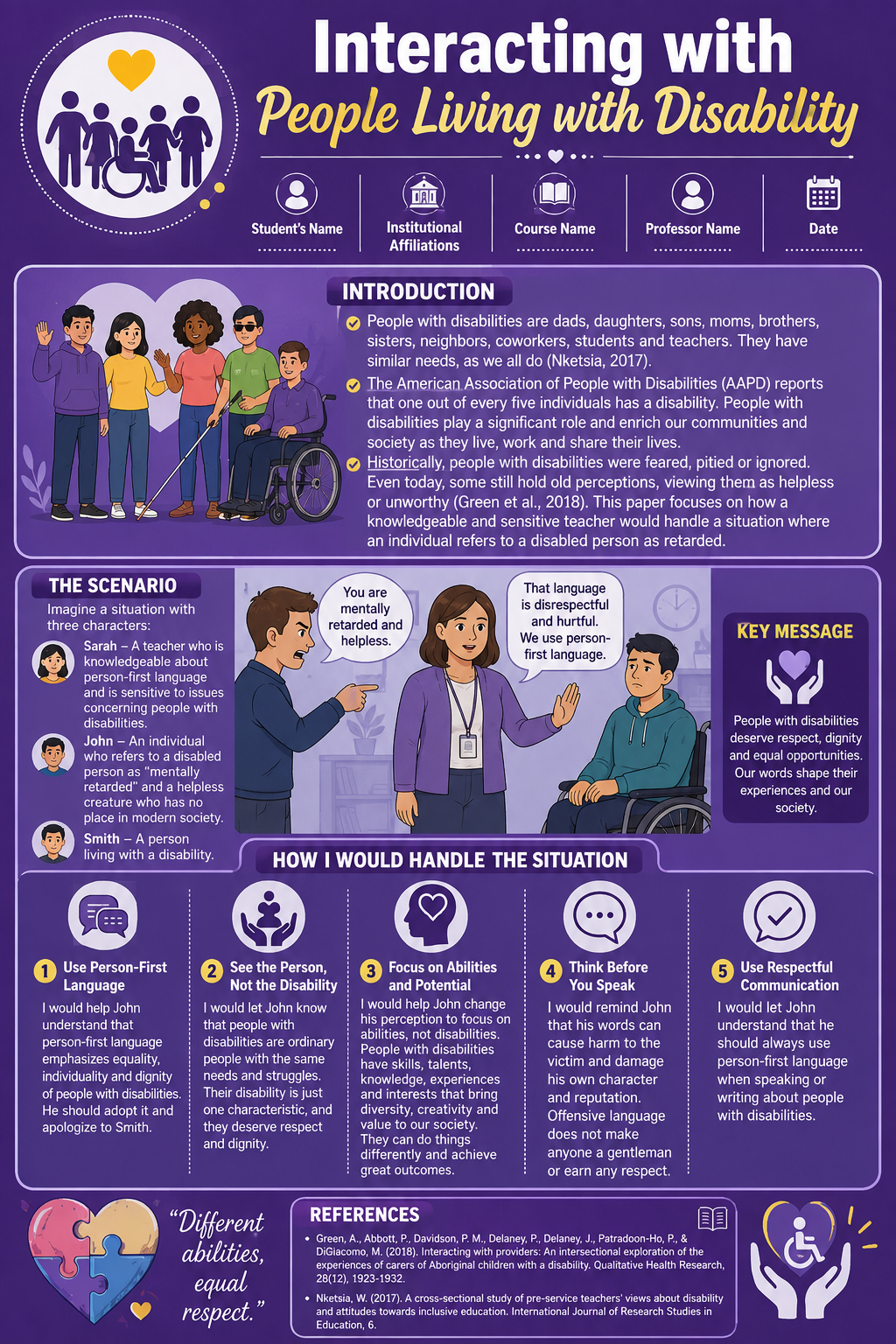
The Scenario
Imagine a situation where an individual is rude towards
a disabled person. By creating an assumption of three characters, Sarah, John
and Smith. Smith is a person living with a disability. Sarah is a teacher who
is conversant with the person-first language and sensitive on issues regarding
the people living with a disability. Sarah finds John abusing Smith as mentally
retarded and a helpless creature who has no room in modern society.
How I would
handle the situation
The above situation requires Sarah to be knowledgeable
on how to approach John. As Sarah, I would help John to understand the use of
the person-first language. This language emphasizes the equality, individuality
and dignity of people living with disabilities. I would also make John
understand that defining people mainly through their disability is wrong and
being disrespectful. John should adopt the person-first language to demonstrate
respect and seek forgiveness from Smith.
Moreover, I would let John understand that people with
disabilities are ordinary people who have the same needs and struggles. As a
matter of fact, their disability happens to be one of the characteristics that
they possess, and they should be treated with respect and dignity.
Furthermore, I would change John's perception of
people living with disabilities to focus on their abilities and not their
disabilities. He should understand that people with disabilities are special
and unique individuals with a wealth of skills, talents, knowledge, experiences
and interests that add huge diversity, resourcefulness and creative potential
or energy to our society. As a result, people with disabilities can do things differently
than people without them; conversely, they can even achieve the same outcomes.
Finally, I would let John understand that it is good to think before he speaks. What he utters or speaks may consequence the victim, the disabled person, and his character and reputation. Being offensive or rude to disabled people does not make him a gentleman or make him win an award. John should use the personal-first language when speaking or writing about people with disabilities.
References
Green, A., Abbott, P., Davidson, P. M.,
Delaney, P., Delaney, J., Patradoon-Ho, P., & DiGiacomo, M. (2018).
Interacting with providers: An intersectional exploration of the experiences of
carers of Aboriginal children with a disability. Qualitative Health
Research, 28(12), 1923-1932.
Nketsia, W. (2017). A cross-sectional study of
pre-service teachers' views about disability and attitudes towards inclusive
education. International Journal of Research Studies in Education, 6.