Market segmentation and target markets
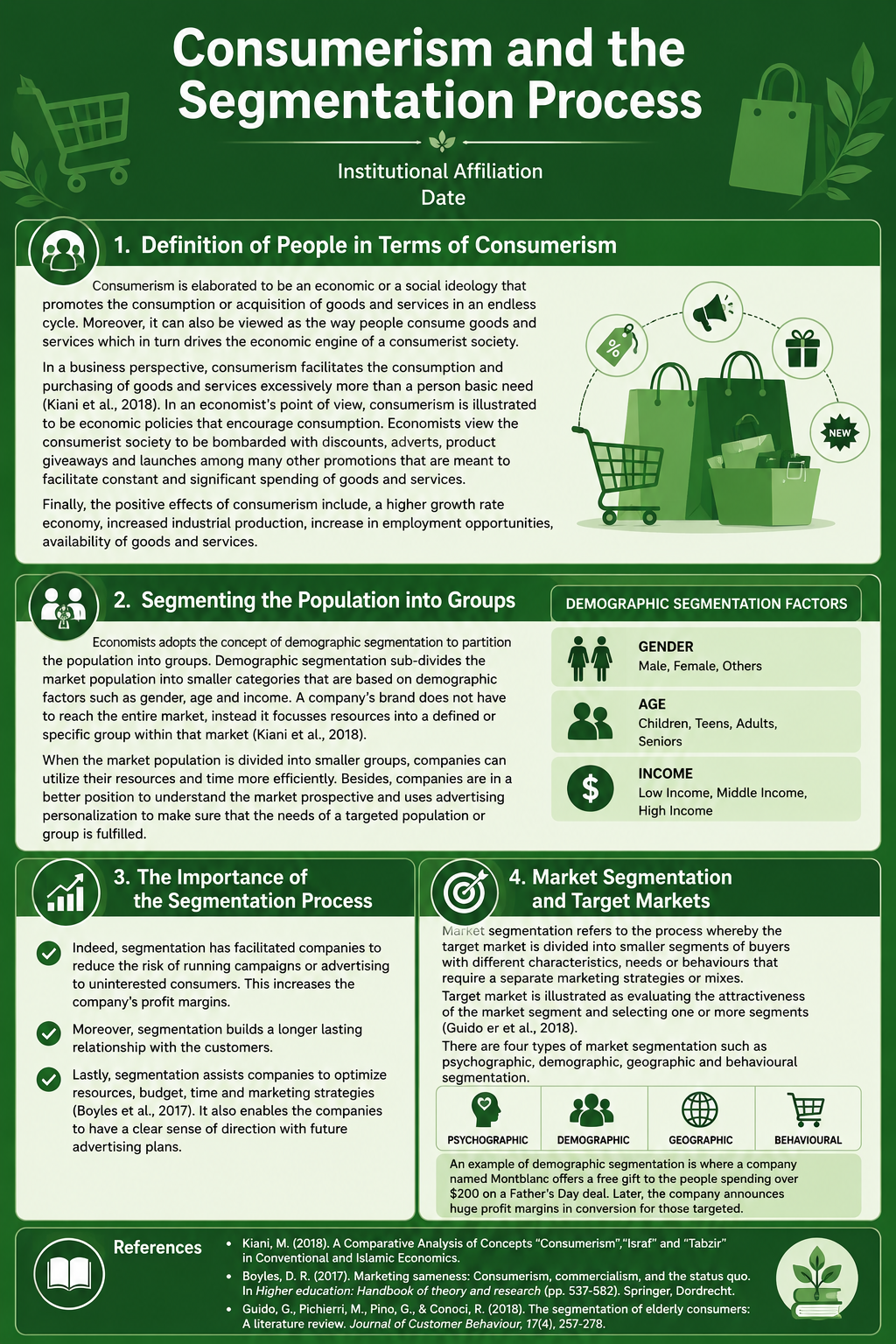
Consumerism
and the Segmentation Process
Institutional Affiliation
Date
Definition of People in Terms of Consumerism
Consumerism
is elaborated to be an economic or a social ideology that promotes the
consumption or acquisition of goods and services in an endless cycle. Moreover,
it can also be viewed as the way people consume goods and services which in
turn drives the economic engine of a consumerist society. In a business
perspective, consumerism facilitates the consumption and purchasing of goods
and services excessively more than a person basic need (Kiani et al., 2018). In an economist’s point
of view, consumerism is illustrated to be economic policies that encourage
consumption. Economists view the consumerist society to be bombarded with
discounts, adverts, product giveaways and launches among many other promotions
that are meant to facilitate constant and significant spending of goods and
services. Finally, the positive effects of consumerism include, a higher growth
rate economy, increased industrial production, increase in employment
opportunities, availability of goods and services.
Segmenting
the Population into Groups
Economists
adopts the concept of demographic segmentation to partition the population into
groups. Demographic segmentation sub-divides the market population into smaller
categories that are based on demographic factors such as gender, age and
income. A company’s brand does not have to reach the entire market, instead it
focusses resources into a defined or specific group within that market (Kiani et al., 2018). When the
market population is divided into smaller groups, companies can utilize their
resources and time more efficiently. Besides, companies are in a better
position to understand the market prospective and uses advertising
personalization to make sure that the needs of a targeted population or group
is fulfilled.
The
Importance of the Segmentation Process
Indeed,
segmentation has facilitated companies to reduce the risk of running campaigns
or advertising to uninterested consumers. This increases the company’s profit
margins. Moreover, segmentation builds a longer lasting relationship with the
customers. Lastly, segmentation assists companies to optimize resources,
budget, time and marketing strategies (Boyles et al., 2017). It also enables the companies to have a
clear sense of direction with future advertising plans.
Market
Segmentation and Target Markets
Market
segmentation refers to the process whereby the target market is divided into
smaller segments of buyers with different characteristics, needs or behaviours
that require a separate marketing strategies or mixes. Target market is
illustrated as evaluating the attractiveness of the market segment and
selecting one or more segments (Guido
er et al., 2018). There are four types of market segmentation such as
psychographic, demographic, geographic and behavioural segmentation. An example
of demographic segmentation is where a company named Montblanc offers a free
gift to the people spending over $200 on a Father’s Day deal. Later, the
company announces huge profit margins in conversion for those targeted.
References
Kiani, M. (2018). A Comparative Analysis of
Concepts “Consumerism”,“Israf” and “Tabzir” in Conventional and Islamic
Economics.
Boyles, D. R. (2017). Marketing sameness:
Consumerism, commercialism, and the status quo. In Higher education:
Handbook of theory and research (pp. 537-582). Springer, Dordrecht.
Guido, G., Pichierri, M., Pino, G., &
Conoci, R. (2018). The segmentation of elderly consumers: A literature
review. Journal of Customer Behaviour, 17(4), 257-278.