Standing Again at Sinai
Comparative
Analysis of Malcolm X’s “Mecca” and Standing Again at Sinai
Introduction
It
is fascinating to examine the beliefs and ideas presented in Malcolm X’s
account of his pilgrimage to Mecca and Rachel Adler’s Standing Again at Sinai.
Malcolm X describes Islam as a religion that promotes unity, spiritual devotion
and fellowship among people from different racial and cultural backgrounds.
This experience contrasts with the racism and racial segregation he encountered
in the United States.
Malcolm
X emphasizes the importance of the pilgrimage to Mecca, known as Hajj, which is
one of the five pillars of Islam. Kirk et al. (2019) explain that Hajj is a
fundamental act of worship required of Muslims who are physically and
financially able to undertake the journey at least once in their lifetime. The
pilgrimage represents religious devotion, obedience and a shared commitment to
Islamic teachings.
The pilgrimage has profound personal and transformative significance for Malcolm X. It provides an opportunity to reflect on his life in the United States, strengthen his faith and seek spiritual renewal. His experiences at Arafat and other sacred locations reinforce the Islamic principles of obedience, sacrifice and submission to Allah. Explore our academic writing services or visit our homepage to learn more about WriterSolutionsPro.
In
contrast, Standing Again at Sinai examines the covenant between God and the
Israelites, an event central to Jewish religious identity and tradition. The
narrative describes the Israelites gathering at Mount Sinai as they prepare to
receive God's commandments. However, the instructions concerning who could
approach the mountain raise questions about women's participation in this
defining moment of Jewish history. This issue introduces a broader discussion
about the representation of women in religious traditions and their roles in
shaping Jewish culture. The purpose of this paper is to compare and contrast
the two works and examine how Islam and Judaism respond to questions of
religious identity, community, gender and modern social challenges.
Summaries of Malcolm X’s “Mecca” and Standing Again at Sinai
Malcolm X was an American Muslim whose pilgrimage to Mecca significantly influenced his understanding of Islam, race and human equality. He had a family that included his wife and daughters. His journey to Mecca, also known as Hajj, exposed him to the hospitality and solidarity of Muslims from different parts of the world.
His
journey began when his sister Ella provided financial assistance. He then
applied for a visa at the Saudi Arabian consulate. However, he was informed
that he needed written approval from Dr. Mahmoud Shawarbi because he had
converted to Islam in America. This requirement initially appeared to be an
obstacle, but it eventually led to further assistance from people who helped
facilitate his pilgrimage. Explore our academic support services or visit our
homepage.
Dr. Shawarbi later invited Malcolm X to his office and provided the necessary approval letter. He also gave him contact details for his son, Muhammad Shawarbi, who was studying in Cairo, and Omar Azzam, who lived in Jeddah. These contacts helped Malcolm X navigate his journey. While travelling, he encountered fellow Muslims who welcomed him warmly and organized a gathering in his honour. When he arrived at Jeddah Airport, he heard Muslims repeatedly saying “Labbayka,” an expression of response and devotion to God. He was also assigned a mutawif, a guide who assists pilgrims during Hajj.
One
of the most memorable experiences was the hospitality Malcolm X received from
Dr. Omar Azzam. When airport officials temporarily confiscated his luggage and
passport, Azzam helped resolve the situation. Malcolm X was soon reunited with
his belongings and welcomed into the Azzam family home. He described the
hospitality he received as extraordinary and unlike anything he had previously
experienced.
Malcolm X was provided with comfortable accommodation and subsequently appeared before a Hajj committee court that had been informed about his circumstances. The judge, Sheikh Muhammad Harkon, treated him generously and presented him with books in English and Arabic. Malcolm X's name was later entered into the register of Muslims, and he received encouragement to become a prominent preacher of Islam in America.
The
Azzam family arranged for two young Arab men to accompany Malcolm X to Mecca.
Upon arriving, he was guided to the Kaaba, the sacred structure at the centre
of the Great Mosque. He performed his prayers and drank water from the well of
Zamzam. At Mount Arafat, he raised his hands in prayer and thanksgiving,
reflecting on his faith and repeating the declaration that there is no god but
Allah. These experiences strengthened his understanding of spiritual equality
and the possibility of relationships that transcend racial divisions.
In comparison, Standing Again at Sinai examines the covenant between the Israelites and God as a defining event in Jewish religious history. However, the account raises concerns about women's visibility and participation in the formation of Jewish identity. Women appear to be positioned outside the central encounter between God and the men of Israel, prompting questions about their place in religious history and tradition.
Rachel
Adler challenges this exclusion by questioning whether women are fully
recognized as participants in Jewish religious life or are primarily assigned
domestic responsibilities. She examines the implications of women's limited
visibility in traditional accounts and asks how Jewish women can claim a more
meaningful place in their religious heritage.
Adler also questions the historical absence of women from positions of religious authority, including the rabbinate in traditions where those roles were restricted to men. She argues for the active participation of women in interpreting and reshaping Jewish tradition. This involves moving beyond anger about historical exclusion toward empowerment, renewed interpretation of the Torah and recognition of women's contributions. Jewish feminists, in this view, can help recover overlooked experiences, develop new liturgical practices and advocate for greater participation in religious leadership. Explore our academic support services or visit WriterSolutionsPro.
Similarities Between Malcolm X’s “Mecca” and Standing Again at Sinai
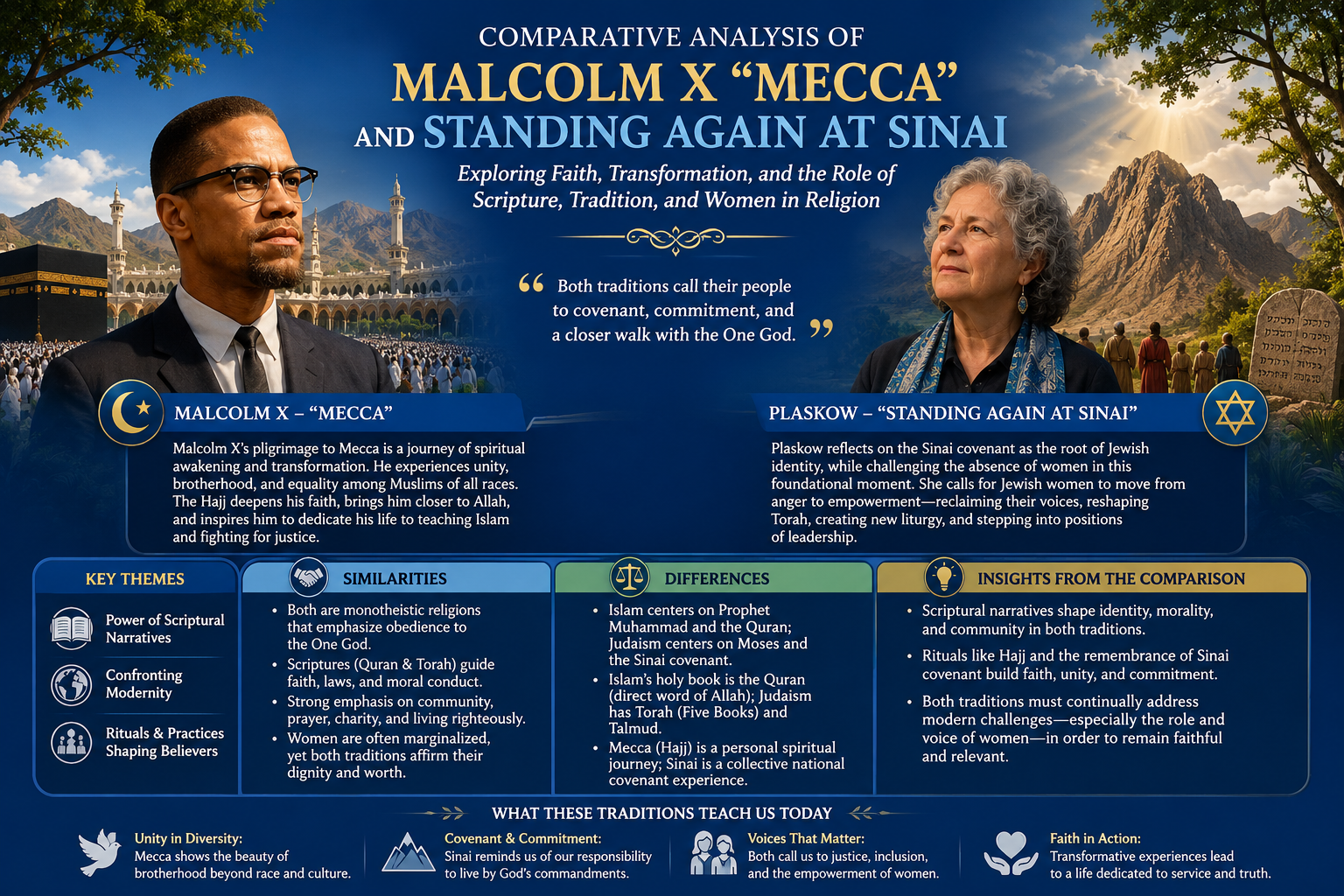
There are important similarities between Malcolm X’s account of Islam and the themes explored in Standing Again at Sinai, which focuses on Judaism. Both works examine religious identity, the relationship between individuals and God, and the influence of religious traditions on community life.
First,
Islam and Judaism are monotheistic religions that emphasize belief in one God
and the importance of religious obligations. Both traditions include practices
of prayer, charity, communal responsibility and adherence to religious
teachings. These principles help shape the moral and spiritual lives of their
followers.
Second,
both traditions draw on sacred texts and religious narratives to guide their
adherents. Muslims regard the Quran as their central scripture, while Jewish
religious tradition centres on the Torah and includes other authoritative
texts, such as the Talmud. These sources shape religious beliefs, ethical
responsibilities and interpretations of the relationship between humanity and
God. Kirk et al. (2019) discuss the importance of religious teachings as
sources of guidance and inspiration.
Third,
both works raise questions about gender and women's roles in religious
communities. Malcolm X's account describes particular social customs and
experiences during his pilgrimage, while Rachel Adler directly examines women's
exclusion from aspects of Jewish religious history and authority. These
perspectives invite discussion about how religious traditions are interpreted
and practised in different historical and cultural contexts. However, it is
important not to assume that all Muslim or Jewish communities treat women in
the same way. Both traditions contain diverse interpretations and practices
concerning women's participation and religious responsibilities.
Differences Between Malcolm X’s “Mecca” and Standing Again at Sinai
Despite their similarities, Islam and Judaism differ in important ways. Malcolm X’s account focuses on the Islamic pilgrimage to Mecca and the spiritual transformation associated with Hajj. In contrast, Standing Again at Sinai focuses on the covenant at Mount Sinai and the implications of that event for Jewish identity, religious authority and women's participation.
Islam recognizes Muhammad as its final prophet and regards the Quran as its central scripture. Hajj is one of the five pillars of Islam and represents an important expression of devotion to Allah. Malcolm X's pilgrimage illustrates how this religious practice can influence personal identity and challenge racial assumptions through encounters with Muslims from different backgrounds.
Judaism,
on the other hand, places central importance on the covenant between God and
the people of Israel, the Torah and the teachings developed through Jewish
religious tradition. Moses is a central figure in the account of the Sinai
covenant, which represents a defining moment in the relationship between God
and the Israelites. Rachel Adler uses this tradition to examine questions about
women's inclusion, religious authority and the interpretation of Jewish
history.
There
are also differences in the central texts of the two religions. The Torah
comprises the first five books of the Hebrew Bible and holds a foundational
place in Judaism. The Talmud contains rabbinic discussions and interpretations
of Jewish law and tradition. Islam's central scripture is the Quran, which
Muslims believe was revealed by God to the Prophet Muhammad. Although both
religions value divine guidance and religious interpretation, their scriptures,
historical narratives and religious practices have distinct roles within each
tradition.
Conclusion
Malcolm X’s account of his pilgrimage to Mecca and Rachel Adler’s Standing Again at Sinai provide different but valuable perspectives on religious identity and tradition. Malcolm X emphasizes the spiritual transformation, hospitality and sense of unity he experienced during Hajj, particularly in contrast with the racism he had encountered in the United States. Adler, meanwhile, examines the historical exclusion of women from important aspects of Jewish religious life and argues for their greater participation in interpreting and shaping tradition.
Both works demonstrate how religious beliefs, sacred texts and communal practices influence people's understanding of identity and responsibility. At the same time, they reveal the importance of examining how religious traditions are experienced and interpreted in changing social contexts. Comparing the two works encourages a deeper understanding of Islam and Judaism, while highlighting the need for thoughtful discussion about equality, inclusion and religious belonging. Get academic writing assistance or visit our website.