Ethics and Public Policy
Honesty, Accountability and Ethics
in Public Administration: Should the Government Officials lie to the Public
Introduction
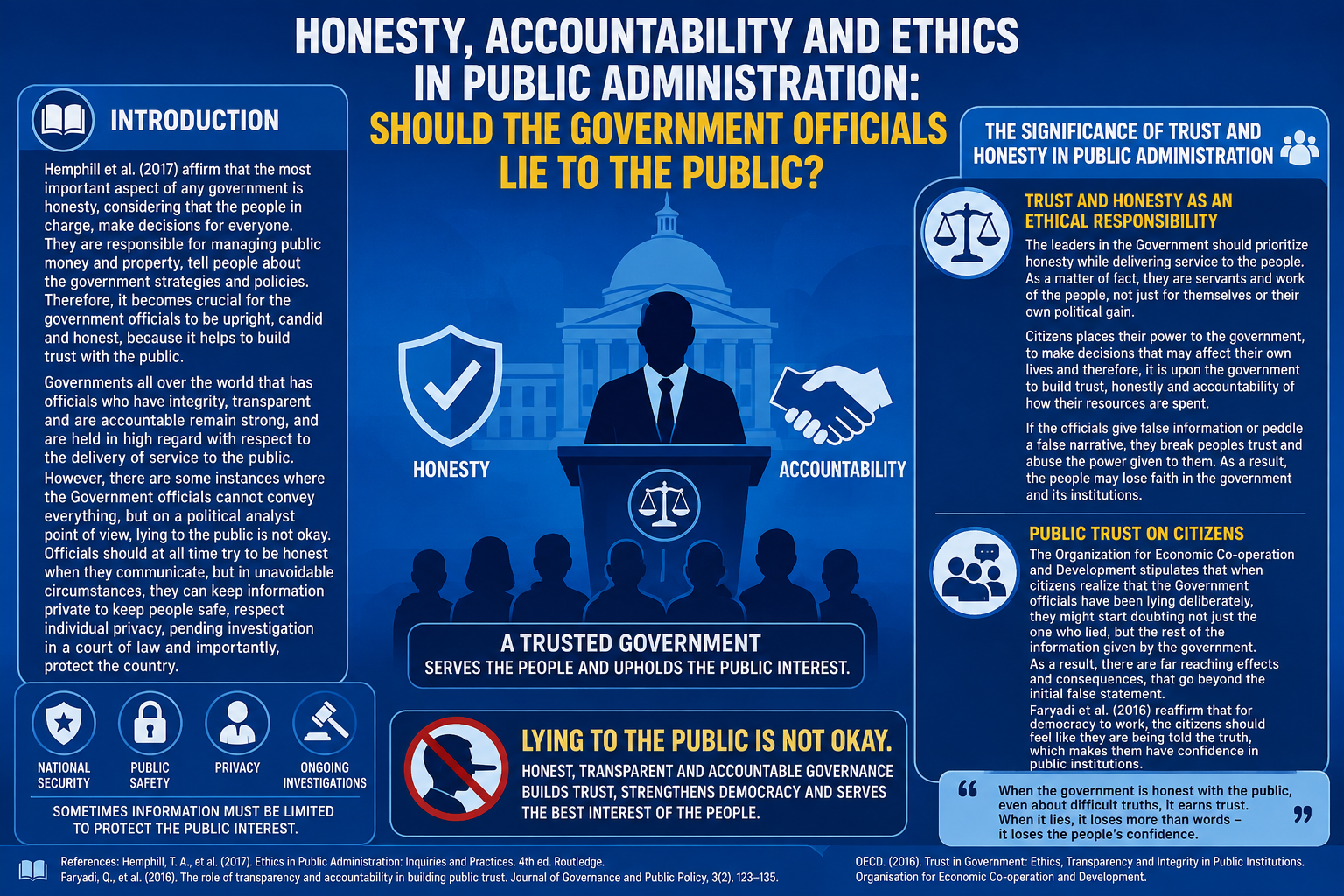
Hemphill et al. (2017) affirm that
the most important aspect of any government is honesty, considering that the
people in charge, make decisions for everyone. They are responsible for
managing public money and property, tell people about the government strategies
and policies. Therefore, it becomes crucial for the government officials to be
upright, candid and honest, because it helps to build trust with the public. Governments
all over the world that has officials who have integrity, transparent and are
accountable remain strong, and are held in high regard with respect to the
delivery of service to the public. However, there are some instances where the
Government officials cannot convey everything, but on a political analyst point
of view, lying to the public is not okay. Officials should at all time try to be
honest when they communicate, but in unavoidable circumstances, they can keep
information private to keep people safe, respect individual privacy, pending
investigation in a court of law and importantly, protect the country.
The Significance of Trust and
Honesty in Public Administration
Trust and Honesty as an Ethical Responsibility
The leaders in the Government
should prioritize honesty while delivering service to the people. As a matter
of fact, they are servants and work of the people, not just for themselves or their
own political gain. Citizens places their power to the government, to make
decisions that may affect their own lives and therefore, it is upon the government
to build trust, honestly and accountability of how their resources are spent. If
the officials give false information or peddle a false narrative, they break
peoples trust and abuse the power given to them. As a result, the people may lose
faith in the government and its institutions.
Public Trust on Citizens
The Organization for Economic
Co-operation and Development stipulates that when citizens realize that the
Government officials have been lying deliberately, they might start doubting
not just the one who lied, but the rest of the information given by the government.
As a result, there are far reaching effects and consequences, that go beyond the
initial false statement. Citizens break down their trust in Government and make
it harder for the officials to communicate. Faryadi et al. (2016) reaffirm that for democracy to
work, the citizens should feel like they are being told the truth, which makes
them have confidence in public institutions.