Culture of Poverty
Culture
of Poverty
How
Does the Sociological Imagination Explain Poverty? A Sociological Analysis.
Learn
how to apply the sociological imagination to poverty through historical,
cross-cultural and critical perspectives, linking personal experiences to wider
social structures.
In
the recent past, people have commonly referred poverty as the state of having
no income or enough resources required to meet basic needs. Indeed, so many people
find it hard to explain why a significant number of people are poor instead of
looking at their personal life and experiences. On a scientific view, an
individual can be unemployed, which can result to a struggle to support a
family, lack of shelter, and even putting food on the table becomes an uphill
task. This condition may be caused by political, social, economic or historical
conditions. For instance, in African countries such as South Sudan, the
political environment, has rendered most of the livelihoods be rendered
homeless and in deplorable state of poverty. A section of the society, in other
countries, like the Afghanistan believe that women should not be educated,
which may result to being financial dependent on men.
The
most important questions that researchers do ask on the issue of sociological imagination
to poverty, is basically through examining an individual experience in
connection to a wider social pattern. For instance, a researcher starts by
looking at the employment opportunities in countries or areas where there is a
high rate of unemployment. Is education affordable and accessible? Are the
employed people receiving sufficient wages to support their household? How are
the economic policies enrolled by the governing authority affect the social
classes. The sociological imagination explain poverty in relation on people absorb
economic hardship with the social structures and historical circumstances surrounding
that hardship.
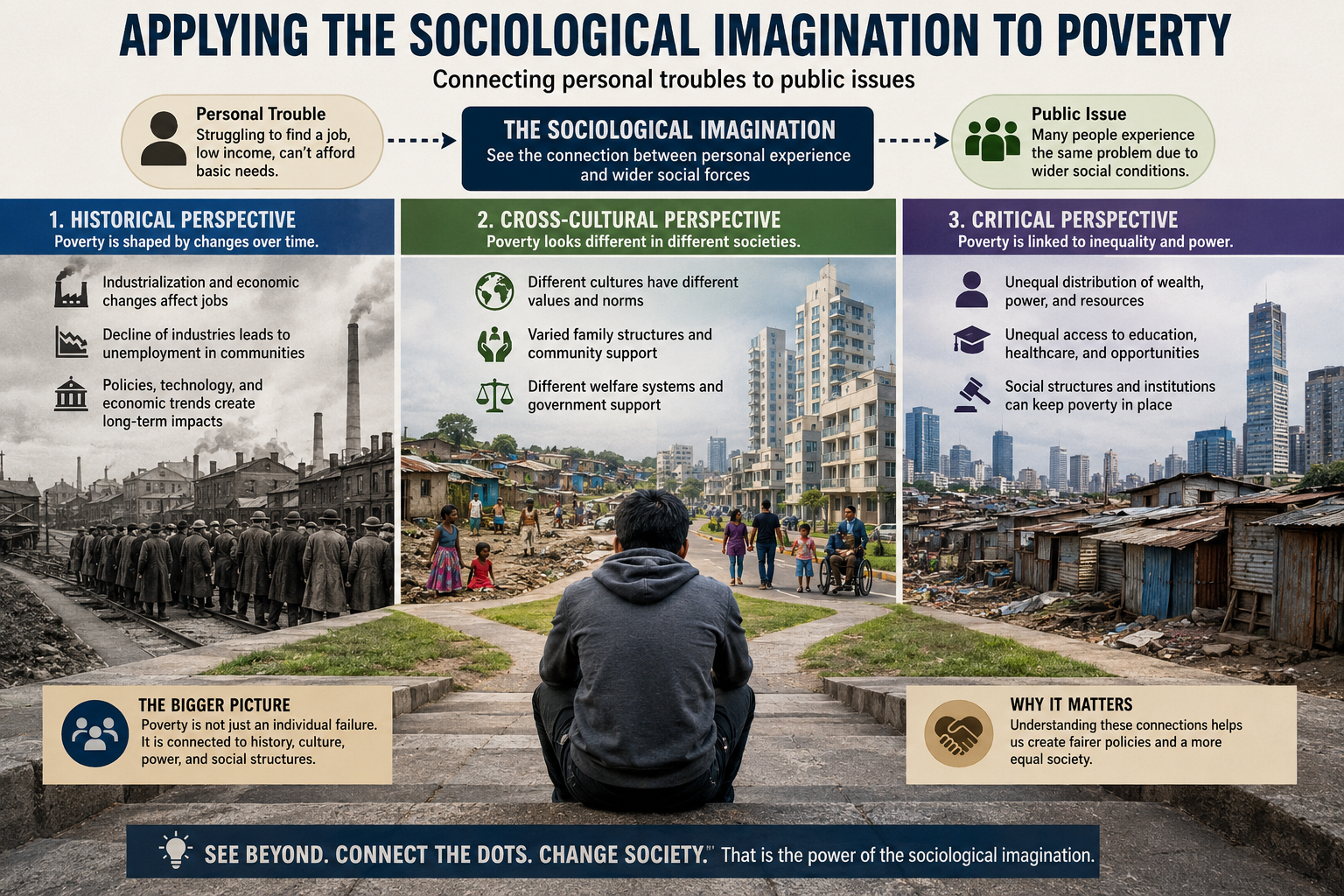
Poverty
through the lens of Historical Perspective
It
is essential to understand the cause of poverty in regard to a historical
perspective of poverty sociology. In history, poverty used to exist in
different forms, but its main cause and consequences underwent an evolution
with the changing society. Economic transformations such as industrialization,
urbanization, rise in technology, and change in the Labour market, has
significantly influenced the way people earn their livelihoods. For instance,
economies have shifted from being dependent on the agricultural production to
industrial or the service-based employment. This benefits people, as they get
access to new opportunities while others may lose their traditional sources of
income. We need to cross examine why an individual may be poor today, which
could be as a result of historical processes which contributed to the economic
conditions affecting that person.
Applying
a Cross-Cultural Perspective on poverty
Langley
et al., (2020) elaborate that poverty do not have the same meaning or
consequences in every society. Research has shown that distinct societies have
different economic systems, welfare arrangements, family structures, cultural
expectations and community support networks. For instance, in countries with a
stable economy, a person experiencing unemployment, may receive support from
the government, such as the health care support, or housing benefits. In distinction,
another unemployed person may result to depend heavily on friends, relatives,
religious organizations or local community networks for support. These
differences can significantly influence how people experience economic
hardship.