Certified Nurse Educators
Understand
how nurses provide effective health education using patient-centered
strategies, teach-back, behavioral objectives, health literacy, and
individualized care plans.
Nurse
as a Health Educator: Roles, Responsibilities, and Patient Education Strategies
Introduction
There
are various duties that a Certified Nurse Educator can perform in a medical
environment such as administering medications, monitoring of vital signs in
patients, or assisting with clinical procedures. Patient education is an important
aspect of nursing practice, as it creates awareness on patients to make
informed decisions, prevent health complications and as a result, they are able
to maintain their health even after leaving a health care facility. This makes
the Certified Nurse Educator as an important stakeholder of both the individual
patient care and broader health promotion.
Indeed,
effective health promotion should not be limited in identifying as to whether a
patient may prefer visual, auditory or hands on learning. Lambert et al.,
(2017) elaborates that patient education needs are significantly influenced by
factors such as health literacy, language, emotional state, previous knowledge,
culture, financial circumstances, family support, physical or cognitive
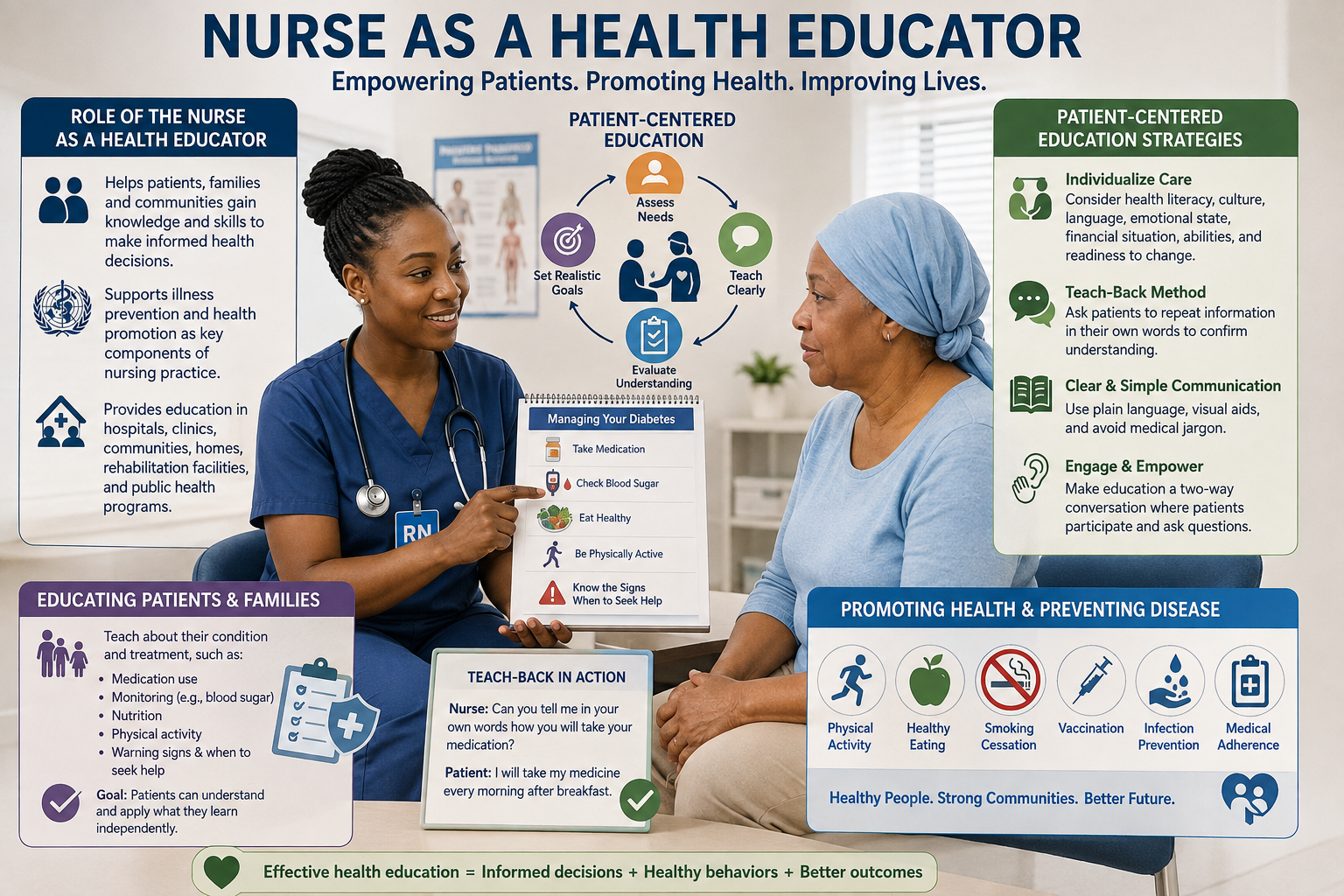
abilities, and readiness to change. When a patient is admitted, the primary
responsibility is for the nurse to assess the individual, outline educational
needs, select appropriate teaching strategies, establish realistic goals,
convey clear information and evaluate whether the patient can apply what has
been taught. Health education should be perceived as a two-way procedure where
a patient participates rather than simply receiving the information.
What
is the Role of a Certified Nursing as a Health Educator?
The
role of a Certified Health Educator is to help patients, families and the
community at large, to acquire the skills and knowledge intended to influence
on how they make informed health decisions. The World Health Organization emphasizes
that illness prevention and health promotion as the most important components
of nursing practice. In distinct medical facilities, community settings,
clinics, homes, rehabilitation facilities, and public health programs, nurses provide
education to patients, or society at large. The subject of education may range
in to different topics such as medication use, exercise, disease prevention,
mental wellbeing, reproductive health and chronic disease management.
Educating
Families and Patients
Kozma
et al., 2019, affirms that one of the most vital functionality of a certified
Nurse Educator is the ability to teach patients and their families issues
concerning their health conditions and treatment. For instance, in a scenario
where the nurse is caring for a patient with diabetes, the nurse may need to explain
about administration of medication, blood glucose monitoring, physical
activities, nutrition, signs of hypoglycemia and when the professional medical assistance
should be sought. This informed should be conveyed to the patient in a manner
that the patient clearly understands and can do it practically without
assistance.
Promoting
Health and Preventing Disease
Certified
Nurse Educators are also tasked with educating people before an illness occur.
Health promotion education can include encouraging appropriate physical
activities, screening, healthy eating, smoking cessation, vaccination, medical
adherence, infection prevention and other preventive behaviors.