Obesity as a public health issue
 Nursing
Community Health Education on Obesity in the US
Institutional Affiliation
Date
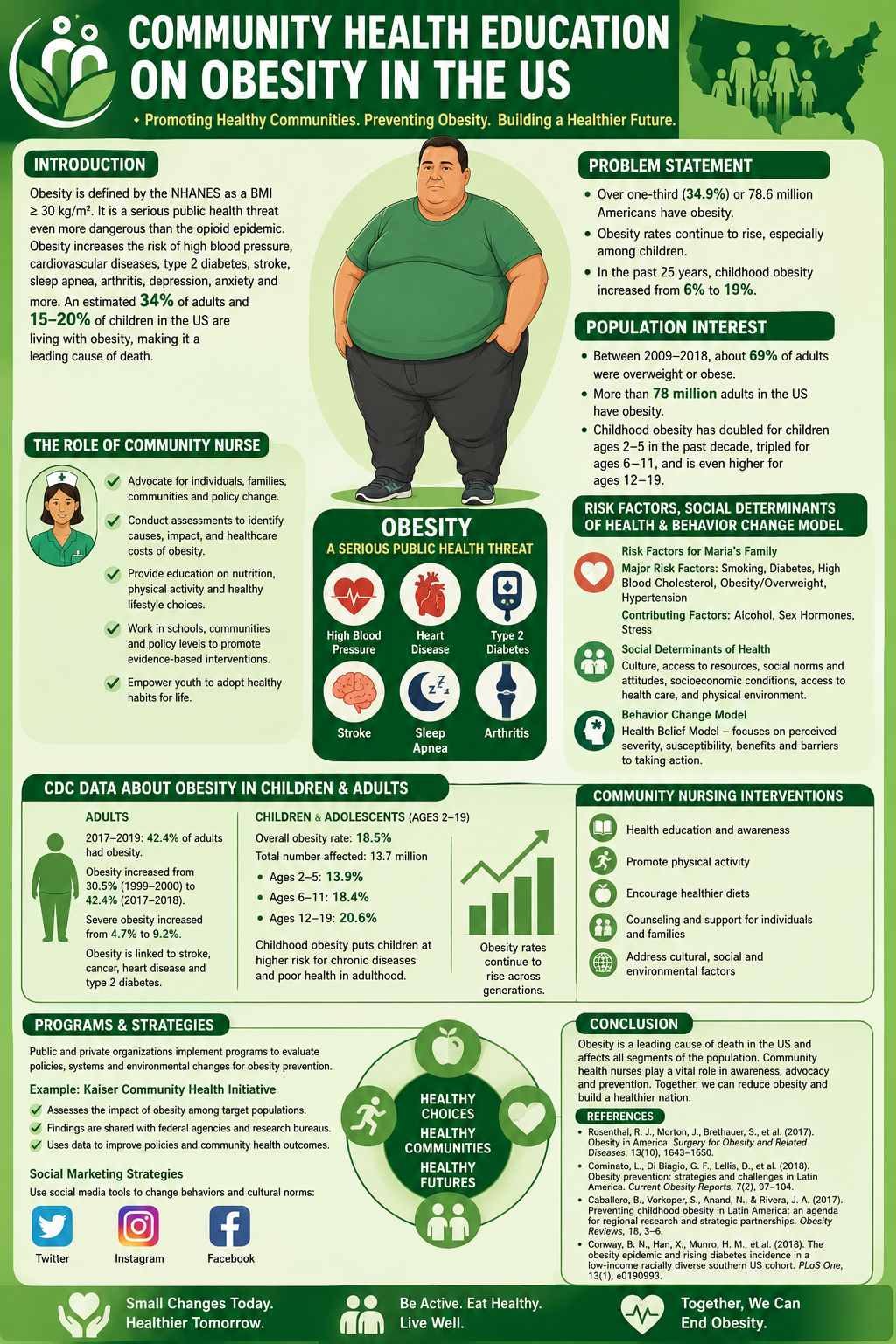
Introduction
Obesity
is defined by the National Health and Nutritional Examination Survey (NHANES)
as people having a bodyweight or a Body Mass Index (BMI) greater than 30kg/m2.
However, it is classified as a grave public health threat that is even
more dangerous than the opioid epidemic. The US Centres for Disease Control and
Prevention (CDC) has illustrated Obesity to be a national epidemic that maximizes
the risk of a person contracting High blood pressure, cardiovascular diseases,
depression, arthritis, sleep apnoea, and breathing problems, high cholesterol
levels, stroke, type 2 Diabetes and anxiety (Rosenthal et al., 2017). The estimated figures show
that 34% of adults and 15-20% of children in the US having Obesity. As a
result, Obesity is classified to be a major cause of death in the US.
Problem
Statement
Obesity
in the US has become a significant challenge in the health sector. In
collaboration with NHANES, CDC performed research and reported that over
one-third, equivalent to 34.9% or 78.6% of the American population, have Obesity
(Rosenthal et al., 2017).
The report indicated that obesity rates did not increase in some US
sub-populations but would increase to maximum levels overtime. Moreover, cases
of Obesity in children are alarming. In the past 25 years, the rate of Obesity
in children had risen from 6% to 19%.
Population
Interest
Obesity
affects both adults and children. The NHANES elaborates that between 2009-2018,
approximately 69% of the adults were obese or overweight. The agency also found
that more than 78 million adult Americans were obese (Cominato et al., 2018). Not only adults but children
were also affected by Obesity. Statistics show that childhood obesity doubled
on children under the bracket of 2 to 5 years in the past decade. Moreover, for
the children between the ages of 6 and 11, the rate of Obesity tripled, and
those aged 12 to 19 were much higher.
The
Role of Community Nurse
To
manage and prevent Obesity, advocacy is essential at the policy level in the US.
However, in the community-based and health care setting, community health
nurses are better positioned to advocate for families, communities, and
individuals in implementing evidence-based activities that aim to minimize
excessive weight gain and Obesity. Furthermore, the community health nurse can
advocate at schools, public policy levels, and the local community. Moreover,
the nurse identifies the attitude and the main concerns of the American
population towards Obesity. The nurses conduct a comprehensive study on the
incidences of Obesity, causes, and the health care cost of Obesity in the US.
The other key role of nurses is providing related information about obesity
management to individuals (Cominato
et al., 2018). Lastly, the nurses are excellent in teaching young people about
physical exercise and nutrition as techniques to keep the body fit.
Risk
Factors for Maria's Family Cardiovascular Disease, Social Determinants of
Health and Behaviour Change Models
Maria's
father is suffering from cardiovascular disease and type 2 diabetes. Her mother
is overweight and high blood levels. Diabetes and high blood pressure are
classified as some of the risk factors for cardiovascular diseases. These risk
factors can be categorized into two parts. Firstly, it is about the major risk
factors. They consist of smoking, diabetes, high blood cholesterol, Obesity and
overweight, and hypertension (Cominato
et al., 2018). Secondly, it is a contributing factor. They include alcohol, sex
hormones, and stress. Conversely, social
determinants of health mainly affect people suffering from cardiovascular
disease. They include culture, availability of resources to meet daily needs,
social norms and attitudes, socioeconomic conditions, and access to health care
services. Physical determinants include natural and built environments. Lastly,
the behaviour model that can be applied in this case is the health belief
model. The model emphasizes how severe the illness is and the challenges
encountered in achieving health promotion.
The
CDC Data about Obesity in Children, Adults and Community Nursing Intervention
From
2017 to 2019, the number of adults with Obesity was 42.4%. The comparison of Obesity
between 1999-2000 through 2017-2018 increased from 30.5% to 42.4% and 4.7% to
9.2% (Caballero et al., 2017).
The conditions that triggered the prevalence of Obesity were stroke, cancer heart
disease and type 2 diabetes.
Moreover,
the CDC reported that children and adolescents at the age of 2-19 years, the
rate of Obesity was 18.5%. The total number of children and adolescents was
13.7 million. On children aged 2 to 5 years, the rate of Obesity was 13.9%,
18.4 on children aged between 6 to 11 years and finally, 20.6% on children
between the age of 12 to 19 years old (Caballero et al., 2017). Community nursing interventions are
crucial for health education, promoting physical activity, healthier diets,
counselling, and changes in familial, cultural, and social environments that
address the broader determinants of Obesity.
Nonetheless,
there are programs created by public and private organizations that evaluate
strategies to be used for measuring policies, systems, and environmental change
in community-level obesity prevention initiatives (Conway et al., 2018). For instance, the Kaiser
Community health initiative. This program's ultimate objective is to assess the
impact of Obesity among the target population. The findings are then presented
to the relevant federal agencies and research bureaus for further scrutiny.
Finally, I would adopt social marketing strategies to change the behaviour and
cultural norms or community standards to improve society's health. I would
adopt the resources like social media marketing tools. They include Twitter,
Instagram, and Facebook.
Conclusion
Indeed, Obesity is one of the leading causes of death in the US. To curb this disease, community health nurses should ensure awareness and advocacy of Obesity to the citizens. Moreover, it affects every segment of the US population. It increases the risk of children and adults contracting chronic diseases.
References
Rosenthal, R. J., Morton, J., Brethauer, S.,
Mattar, S., De Maria, E., Benz, J. K., ... & Sterrett, D. (2017). Obesity
in America. Surgery for Obesity and Related Diseases, 13(10),
1643-1650.
Cominato, L., Di Biagio, G. F., Lellis, D.,
Franco, R. R., Mancini, M. C., & de Melo, M. E. (2018). Obesity prevention:
strategies and challenges in Latin America. Current obesity reports, 7(2),
97-104.
Caballero, B., Vorkoper, S., Anand, N., &
Rivera, J. A. (2017). Preventing childhood obesity in Latin America: an agenda
for regional research and strategic partnerships. Obesity Reviews, 18,
3-6.
Conway, B. N., Han, X., Munro, H. M., Gross, A.
L., Shu, X. O., Hargreaves, M. K., ... & Blot, W. J. (2018). The obesity
epidemic and rising diabetes incidence in a low-income racially diverse
southern US cohort. PloS one, 13(1), e0190993.